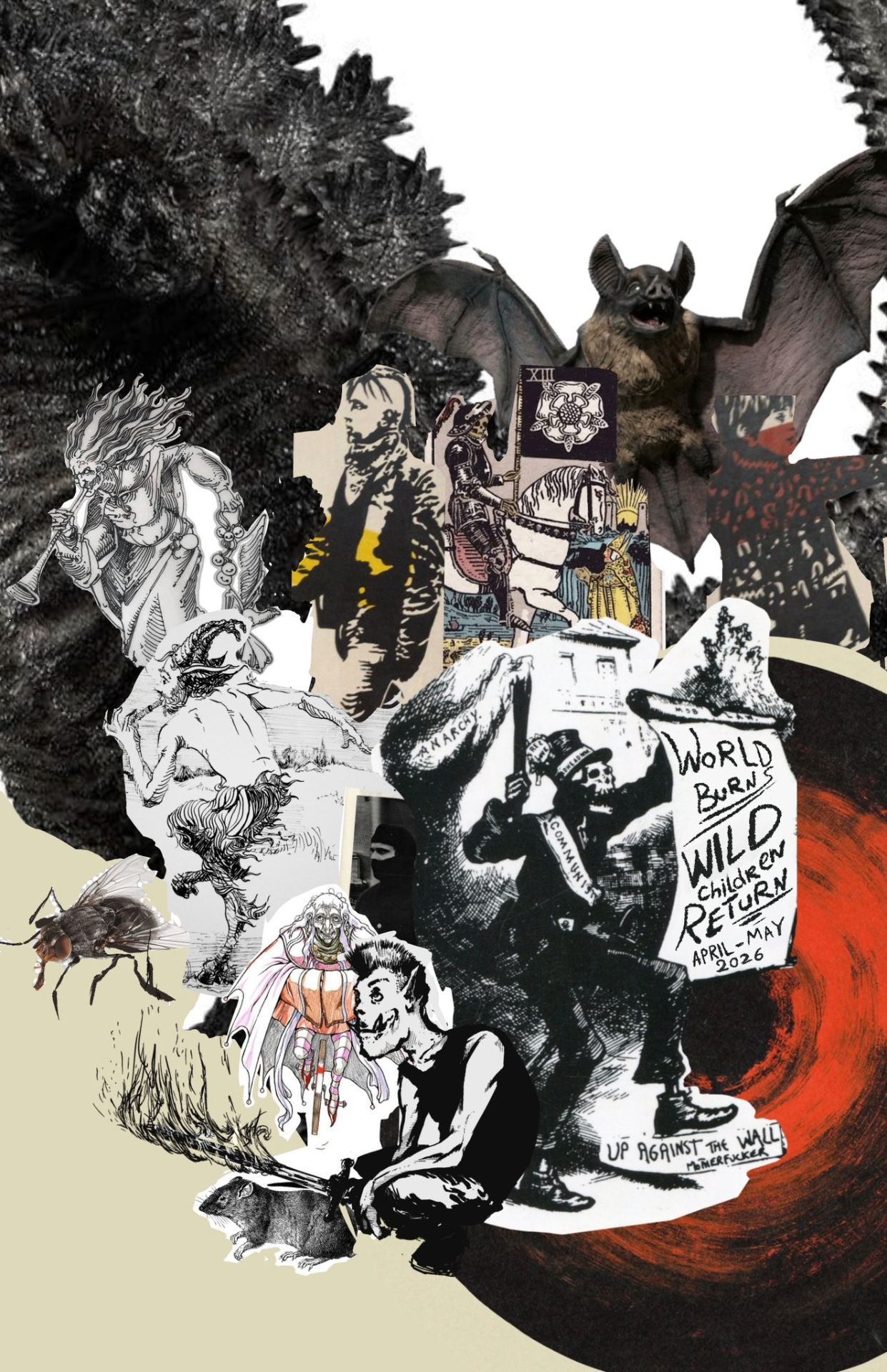
Wild Children: 30th Annual Alternative Art Festival
1/3 Buzand St, Yerevan Directions
The 30th edition of NPAK's legendary alternative art festival. Featuring Ben Morea, Ayreen Anastas & Rene Gabri, Claire Fontaine, Susanne Fassbender, and more. Includes events, games, workshops, temporary library, temporary cinema, temporary kitchen, flea market, and a delegation from Italy. Initiated by Grigor Simonyan and Tigran Khachatryan. Wild children don't submit applications; they act while adults draft charters and strategies. Their work thrives in temporary autonomous zones where nothing can be owned – it doesn't serve, adapt, or comfort. The 30th Annual Alternative Art Festival is not a summation. It looks at emptiness not as an absence, but as a potential where art once again becomes life. "The 2008 crisis is not over yet. During the Great Recession, it became clear that the neoliberal political model was not working worldwide. Its connection to economic problems became evident to all of us, as the crisis was already capitalist. The 'democracy' that began to be built after independence was in crisis. With the 1998 coup, it was fully formed and simultaneously failed. In Armenia, the dilemma was very clear: either real democratization or overt authoritarianism. Instead of radical changes, we got a meaningless Mashtots Park. The problem is that the events of that time formed activist movements among us and were able to play a decisive role in the course of subsequent events. In the early 2010s, some left-wing ideas became relevant. The generation that grew up after the Soviet Union tried to think about post-independence contradictions in a language that made their parents cringe. These were sympathetic but weak attempts. Abstract criticism allowed for the combination of even opposing political ideas. On the same stage, one could meet street artists and start-up founders, counter-cultural figures, artists and art workers, meritocrats, technocrats and anthroposophists, vegetarians, suddenly wealthy programmers, drug dealers, proponents of institutional relations and progressive fascists, LGBT activists, founding presidents, founders of various translation schools, boys and girls who betrayed their class, expressionists yearning for the title of people's artist, those conducting historical-critical studies, former political prisoners and art sellers, those who preferred the clay moment to the embrace, members of the Karabakh Committee, documentarians, social artists, nonconformists and opportunists, reactionaries, comrades and individualists, creative politicians, Dashnak poets, those complaining about the deficit of professionalism, descendants of survivors, homemakers, freedom fighters, pacifists, paranoids, party members and diligent taxpayers, ordinary philistines, and why not hipsters, those suffering from unrequited love, those affected by non-canonical relationships, introducers of new struggle strategies, pioneers of marijuana legalization, those who believed in the liberating power of the internet, proponents of cultural revolution, those who clearly saw the connection between economic problems and neoliberal politics, re-interpreters of Soviet modernism, pensioners, spoiled brats, and future bureaucrats. The dividing line ran between democratic demands and the legacy of the 90s, which was burdened by the Soviet legacy. Everything went its course: Velvet Revolution, pandemic, wars, snap elections. By the end of the 2010s, the political field was emptied. The problem is not even that the criticism of the government's social policy is now combined with admiration for that same government, but that many "leftists" successfully performed on those platforms. Moderate solutions are truly meaningless now. To provide opposition services to the population, one can attach oneself to one of the long-discredited parties. One of the consequences of emptiness is widespread depoliticization – from opportunism to theoretical abstractions. The interim moment has dragged on. But at the same time, society as a whole is oppressed not so much by repression as by depression caused by devaluation. The problems of the left are, after all, the problems of society: as such, weakness of solidarity, fragile connections, lack of experience. You see the results of the 2008 "Great Recession" today, and it can continue to cause chaos and destruction on a global scale. Those who try to turn back the clock to the once "golden age of supremacy" will fall into illusion, because no new stable system will form in the near future. And yet, paradoxically, against the backdrop of moral and political collapse, we are today at least more visible and more capable of developing autonomous initiatives at all levels. The 30th Annual "Wild Children" alternative festival is not just a platform for direct display, but a place for ideas – if, of course, they exist, both aesthetically and politically. While the left is associated with the past, we have no future. It has nothing to do with calculation – two steps forward, one step back, and one plus one does not equal two, because we can count to three, and if they teach us to continue counting, we will find ourselves in an infinity of numbers. Feminists have long spat on Hegel, and Mickey Mouse flies to Mars and his laughter pierces steel. We want to live in a dirty city where children smell of sweat and gunpowder. Initiators of the 30th Annual Alternative Art Festival: artists Grigor Simonyan and Tigran Khachatryan
Source: website